 Free 30 day trial
The complete stock and warehouse management system
Sep 10, 2026
When Should Your Business Invest in Warehouse Management Software? 7 Signs It’s Time
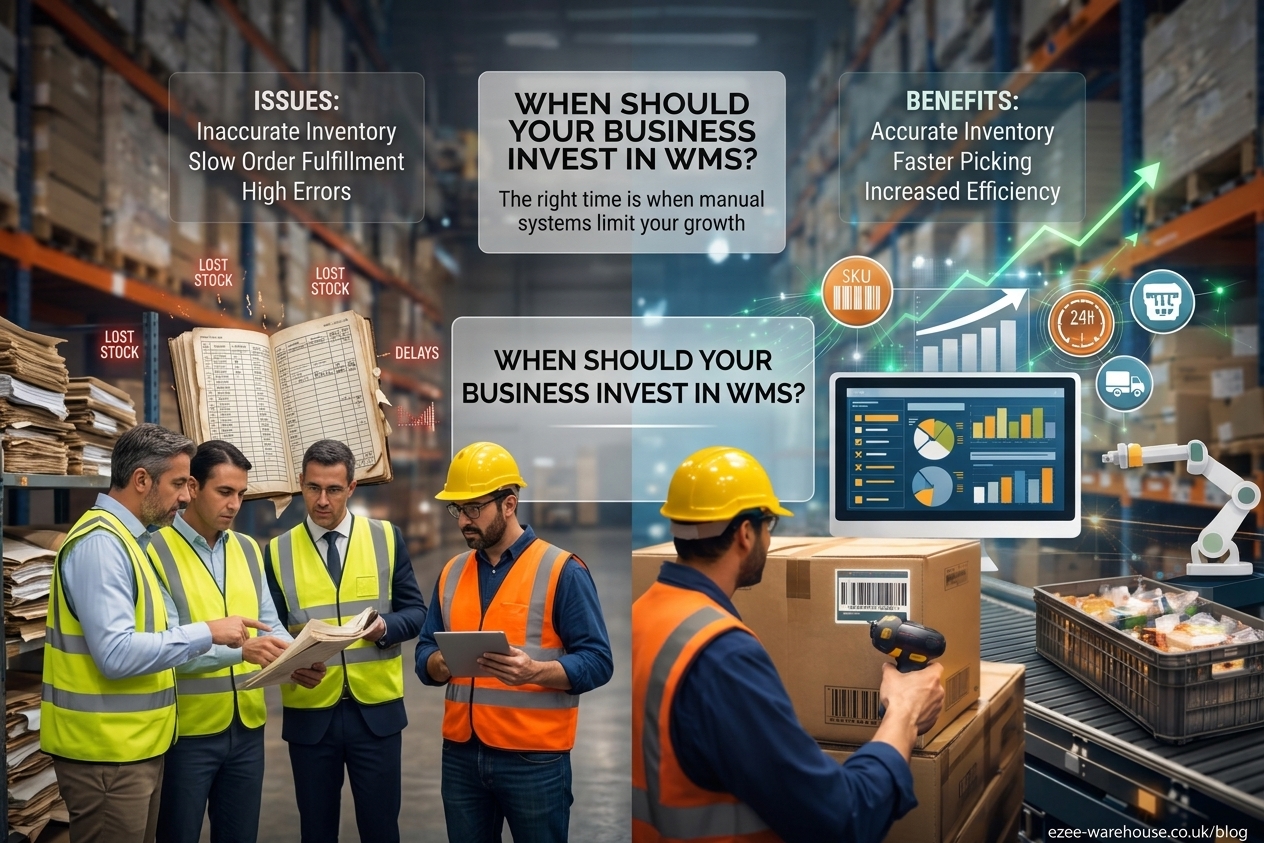
Running a warehouse with spreadsheets, paper-based processes and manual stock checks might work when your business is small. But as orders increase, products multiply and customers expect faster delivery, those same processes can quickly become a source of errors, wasted time and unnecessary costs.
This is where warehouse management software (WMS) can make a significant difference. A modern WMS gives you greater visibility and control over your stock, orders and warehouse operations.
But how do you know when the time is right to invest?
Here are seven signs that your business may have outgrown its existing warehouse processes.
1. You’re spending too much time looking for stock
One of the clearest warning signs is when warehouse staff regularly have to search for products.
If employees rely on memory, paper lists or spreadsheets to locate stock, valuable time can be lost simply finding the right item.
A warehouse management system can record where stock is stored and provide real-time visibility of product locations and quantities. This means your team can spend less time searching and more time picking and processing orders.
2. Your stock records don’t always match reality
Knowing exactly what you have in stock is essential.
If your system says you have 50 units but the warehouse only contains 43, it can lead to overselling, delayed orders and unhappy customers.
Manual data entry is particularly vulnerable to mistakes. Barcode scanning and real-time inventory updates can help reduce these errors by recording stock movements as they happen.
With eZee Warehouse, businesses can track stock from goods-in through picking, packing and despatch, creating a detailed audit trail of inventory movements.
3. Order volumes are increasing
Growth is a great thing — but warehouse processes that worked for 50 orders a day may not work for 500.
As order volumes increase, manual processes can become bottlenecks. Picking lists take longer to create, staff spend more time walking around the warehouse and mistakes become more likely.
A WMS can help organise the entire fulfilment process.
Orders can be received into the system, picking lists generated and warehouse staff guided through the picking process. Different picking methods, including single-order, batch and zone picking, can be used depending on how your warehouse operates.
4. You’re making too many picking and packing mistakes
A wrong product, incorrect quantity or missed item can quickly turn into an expensive problem.
There are the costs of returns and replacement deliveries, but there is also the impact on customer satisfaction.
Barcode scanning can help warehouse operators confirm that they are picking the correct products and quantities. Instead of relying entirely on manual checks, the system provides another layer of verification.
For growing eCommerce and 3PL businesses, improving order accuracy can have a direct impact on customer experience.
5. Your warehouse relies heavily on spreadsheets
Spreadsheets can be useful tools, but they aren't necessarily designed to manage increasingly complex warehouse operations.
When multiple people are updating spreadsheets, information can become outdated or duplicated. It can also become difficult to understand what has happened to a particular product or order.
A WMS provides a centralised system where inventory, orders and warehouse transactions can be managed together.
Instead of asking:
“What does the spreadsheet say?”
your warehouse team can work from the same live information.
6. Your customers want better visibility
If you operate a 3PL warehouse, your customers increasingly expect access to accurate information about their stock and orders.
Regularly sending spreadsheets or manually answering stock queries can take valuable time away from your team.
A warehouse management system can provide up-to-date information on stock levels, order status and warehouse transactions.
eZee Warehouse also offers customer portal functionality, allowing customers to access relevant information without giving them unrestricted access to your entire system.
7. You’re connecting more systems together
Modern warehouses rarely operate in isolation.
An eCommerce business might use a platform such as Shopify or WooCommerce, an accounting system such as Xero and one or more courier services. A 3PL may also need to manage information for multiple customers and sales channels.
If these systems don't communicate effectively, employees may find themselves repeatedly entering the same information.
API integrations can help automate the movement of information between systems, reducing manual data entry and keeping information consistent.
eZee Warehouse supports integrations with a range of eCommerce, accounting and delivery platforms, with new integrations being added regularly.
So, is it time for a warehouse management system?
If several of these problems sound familiar, it could be a sign that your warehouse has reached the point where manual processes are holding back your business.
The right WMS shouldn't make your warehouse more complicated. It should do the opposite.
It should help your team:
- Know exactly what stock you have and where it is
- Receive goods more efficiently
- Pick and pack orders accurately
- Reduce manual data entry
- Track stock movements
- Improve order visibility
- Connect your warehouse with other business systems
- Make better decisions using real-time information
Choose a WMS that can grow with your business
Every warehouse is different, so choosing a system that can adapt to the way you operate is important.
eZee Warehouse has been designed for businesses that want greater control over inventory and warehouse operations, whether you're running an eCommerce operation or providing 3PL services.
The platform covers goods-in, inventory management, order management, picking and packing, despatch, barcode scanning, reporting and integrations — all within one warehouse management system.
There are also different plans available, making it possible to start with the functionality you need and scale as your operation grows.
Ready to make your warehouse management eZee?
If spreadsheets, manual processes and stock discrepancies are becoming a problem, it may be time to see what a modern warehouse management system can do for your business.
Try eZee Warehouse free for 30 days — with no credit card required — or book a demonstration to see how it could fit into your warehouse operation.